Nov 03 , 2026
You buy a watch with a dial cut from a rock older than Earth. A month later, you spot a tiny orange speck on it. That would sting.
If you have ever worried about meteorite dial rust, you are in good company. It is one of the first questions new collectors ask us at Ocean Crawler. The honest answer is reassuring, but the details matter. Below, we explain why these dials can rust, how makers protect them, and what you can do each week to keep yours looking sharp. We will also cover how Charlotte’s muggy summers play into all of this.
Can a Meteorite Dial Rust? The Short Answer
Yes, a meteorite watch dial can rust, but it is uncommon in a sealed watch that gets basic care. Meteorite dials come from iron meteorites. Iron reacts with water and oxygen. Makers treat the dial and the case blocks most moisture, so the risk is real but manageable.
Think of a cast-iron pan. Left wet in the sink, it rusts. Kept dry and cared for, it outlasts its owner. A meteorite dial follows the same logic.
What Makes a Meteorite Watch Dial Different
Most dials are brass discs coated in paint or lacquer. A meteorite dial is a thin slice of real space metal.
Only about 5 percent of observed meteorite falls are iron meteorites, and that is the family dial makers use. These dials average about 90 percent iron, and the meteorite slice is often just 0.20 to 0.40 mm thick, glued onto a brass base.
The famous crosshatch look has a name. The ASU Center for Meteorite Studies explains that the Widmanstätten pattern comes from two interlocking nickel iron alloys called kamacite and taenite. Makers reveal it with an acid etch. No two dials match, which is why collectors love them.
Why Meteorite Dial Rust Happens
Four things usually cause it:
- Iron is the main ingredient. Stainless steel carries chromium to resist rust. A meteorite slice does not work that way.
- Salts can hide in the metal. Some meteorites sat in soil for ages and picked up salts, and salts pulled water out of the air.
- Etching leaves a fine texture. Acid reveals the pattern, but the surface is not perfectly smooth.
- Moisture finds a way in. A loose crown, an old gasket, a steamy shower, or heavy sweat can all let humidity reach the dial.
Even a fresh meteorite fall is not safe from this.
Meteorite Dial Rust Risk by Situation
Not every day is equal. Here is how we rate common situations.
|
Situation |
Rust Risk |
Smart Move |
|
Office wear with the crown screwed down |
Low |
Wipe the case once in a while |
|
Sweaty summer afternoon |
Medium |
Dry the case with a soft cloth |
|
Lake, pool, or ocean swim |
Medium |
Rinse in fresh water, then dry fully |
|
Hot shower, sauna, or hot tub |
High |
Take the watch off |
|
Storage in a damp drawer |
High |
Use a dry box with silica packs |
|
Gaskets not tested for years |
High |
Book a pressure test |
How Makers Protect a Meteorite Dial
A good dial is never left bare. Horopedia reports that makers commonly shield the meteorite with electroplating such as rhodium or gold, or with vapor coatings like PVD and DLC.
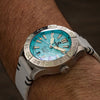
The finish matters, and so does what sits around it. On our Dream Diver Polar Ice Meteorite, the dial is cut from Muonionalusta, a meteorite that fell in Scandinavia about a million years ago. A controlled plasma process gives it that icy blue tone. Each dial keeps its own pattern.
Muonionalusta also has a reputation among collectors for taking on moisture when left raw. That is exactly why we pair these dials with a serious case:
- 316L stainless steel case
- 3.5mm domed sapphire crystal
- Screw down the crown and helium escape valve.
- 600 meters of water resistance
- Swiss Sellita automatic movement inside
A dial sealed behind that setup sees very little water. Most meteorite dial rust stories start with a failed seal, not a failed rock.
Does Charlotte Humidity Matter for Your Meteorite Watch?
It does, a little. We are based in Ballantyne, so we see how the Queen City treats watches.
Climate data shows Charlotte’s relative humidity averages about 69 percent across the year, and the city logs roughly 39 days at 90°F or higher. That means sticky air is normal here, and sweat is part of the deal.
Think about a typical Charlotte week:
- Walking Uptown on a July lunch break
- Tailgating outside Bank of America Stadium
- A day of rapids at the U.S. National Whitewater Center
- Boating on Lake Norman or Lake Wylie
- A weekend at the coast with salty air
None of these will ruin a sealed watch. They do add moisture and salt, so a quick wipe and rinse after each one pays off. If you search for a meteorite watch near you in Charlotte, ask any seller how the dial is finished and how the case is tested. A good seller will answer plainly.
7 Habits That Keep Meteorite Dial Rust Away
- Screw the crown down every time. Make it a reflex after setting the time.
- Wipe the case after sweaty days. A dry microfiber cloth works fine.
- Rinse in fresh water after lakes, pools, or the ocean. Then dry the case and bracelet well.
- Skip hot showers, saunas, and hot tubs. Heat and steam push moisture past gaskets.
- Store it dry. A watch box with silica gel packs beats a bathroom shelf.
- Pressure tests the case every two to three years. Gaskets age, even when the watch looks perfect.
- Check the dial monthly. Use bright light and a loupe if you have one.
Never spray cleaners near the dial, and never open the case back at home. Leave that to a watchmaker.
How to Spot Early Meteorite Dial Rust
Early rust is small, so you need to look for it. Watch for:
- Tiny orange or brown specks
- A dull haze over part of the pattern
- Spots that appear near the dial edge or under the hour markers
- Moisture or fog under the crystal
A slight shift in tone as light moves across the pattern is normal. Orange specks are not. If you see them, stop wearing the watch, keep it dry, and get it checked fast. Rust can spread under a coating, so early action saves the dial.
Choosing a Meteorite Watch You Can Trust
Wondering where to start? We build every Ocean Crawler in the United States, in small batches, with a Swiss automatic movement. Our Charlotte team can walk you through what to look for in any meteorite piece.
You can browse our full Unique Dials collection for rare materials. Meteorite fans often look at the Bolt North Atlantic Meteorite first. Our warranty page spells out what is covered, so read it before you buy any watch.
Final Thoughts
Meteorite dial rust is a real thing, but it is not a reason to skip these watches. A sealed case, a protected dial, and a few easy habits keep the risk very low. Treat your watch the way you would treat a good cast-iron pan, and it will last.
Have a question about a specific model or how to care for your dial? Get in touch with our team. We are happy to help, whether you live near Uptown Charlotte or across the country.
FAQs
Will a meteorite watch dial rust in humid places like Charlotte?
Rarely, if the watch is sealed and cared for. Charlotte’s humid summers raise the stakes, but a gasketed case and a protected dial block most moisture. Keep the crown screwed down and avoid steamy rooms.
Is it safe to wear a meteorite watch at Lake Norman or the U.S. National Whitewater Center?
Yes, if the crown is fully screwed down and the case is rated for it. Our Dream Diver Polar Ice is rated for 600 meters. Rinse with fresh water after lake or pool trips and dry the case.
How can I tell if meteorite dial rust is starting?
Look for tiny orange or brown specks, a dull haze on the pattern, or spots near the edge of the dial. Early signs are small. Check under bright light and a loupe every few months.
Can meteorite dial rust be repaired?
Sometimes, but it takes a skilled watchmaker. A pro can swap the dial or may clean light spots, yet raw rust can spread under a coating. Stop wearing the watch and get it checked quickly.
Where can I find a meteorite dial watch near me in Charlotte?
Ocean Crawler is based in Ballantyne, Charlotte, and offers free shipping. You can browse our Unique Dials collection online or contact us with questions about meteorite dials before you buy.