Aug 13 , 2026
As someone who is buying his or her first mechanical wristwatch, or perhaps an American who is adding to his or her collection, you must have questioned yourself on how the watch works without a battery.
At Ocean Crawler, we spend our days creating, building, and testing durable watches right here in Charlotte, NC. Concentrating on superior performance Swiss automatic watches built to withstand tough conditions, we know firsthand the intricate design behind the watch face.
The mechanical wristwatch is truly an engineering wonder. Under the casing, there are literally hundreds of minuscule pieces that all work together to accurately keep track of time. This tutorial will explain how the mechanisms in a Swiss automatic watch actually work, what they do, and how accurate and maintainable they are.
What You'll Learn
-
Key differences between automatic and quartz watches
-
Swiss automatic watch movement structure: let’s take a closer look
-
Path of energy transfer from the wrist to the watch hands
-
Reality behind power reserves, accuracy, and COSC certificates
-
Tips on maintaining automatic dive watches
The Short Answer: How a Swiss Automatic Watch Works?
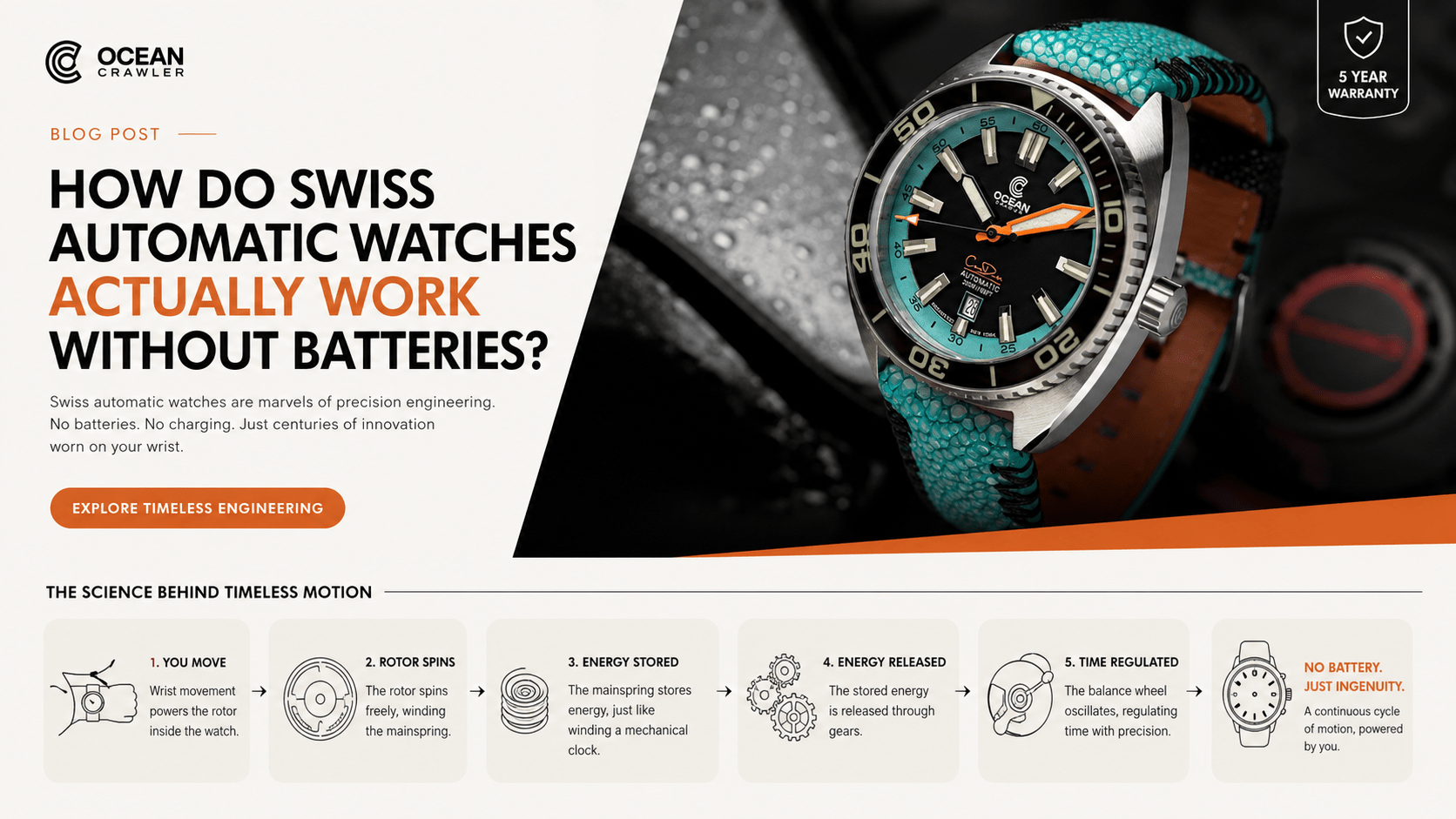
The Swiss automatic watch is designed to use your kinetic motion, which means that the watch uses the motion of your wrist to generate energy. There is a semi-circle-shaped weight, which, when in motion, winds up a coiled main spring. The main spring unwinds slowly to generate energy using gears.
The Core Components of an Automatic Movement
In order to understand how it operates, it is important to analyze each component of the automatic mechanism in turn. Whether analyzing a workhorse caliber such as Sellita SW200-1 or an expensive in-house movement, the basic construction is always the same.
1. The Rotor (Oscillating Weight)
The rotor is made up of a metal semi-circle having some weight attached to it and is positioned behind the movement. The rotor revolves continuously around a pivot, which is ball-bearing supported; due to gravitational force, the rotor rotates downwards when one moves the wrist.
2. The Mainspring and Barrel
This energy from the rotor is transferred into the mainspring, which is a flat spiral spring made of a specific type of metal alloy contained in a small cylinder that is called the barrel.
3. The Gear Train
In the process of releasing its stored-up energy, the winding of the mainspring will have slowed down gradually. In case there was a sudden release of energy by the mainspring, then the hands of the watch would move in an uncontrolled manner. However, this is controlled by making the energy pass through the set of wheels known as the gear train.
4. The Escapement
Escapement works as the mechanism that acts as the braking system for the watch. Escapement comprises the escape wheel and pallet fork. Energy is transferred from the gear train in controlled portions through this mechanism. When you listen to a mechanical watch held against the ear, the sound produced is due to the action of the escapement.
5. The Balance Wheel and Hairspring
Energy is supplied to the escapement through the balance wheel, which beats steadily under the influence of a tiny spiral spring, known as the hairspring. Today’s Swiss watches have balance wheels that vibrate at 28,800 times an hour, or 4 Hertz. The high frequency contributes to the graceful rotation of the second hand.
6. Jewel Bearings
Swiss movements are frequently encountered with the label “26 Jewels.” This is not referring to diamonds but to rubies, which have been artificially made to reduce friction. The rubies, which are extremely hard and used to reduce metal-to-metal contact, are positioned at the pivots of the gear train and escapement.
Step-by-Step: The Flow of Energy
How do these parts work together? The transfer of energy in a mechanical watch is a perfectly sequential process.
-
Generation: It is the physical movement of your arm that makes the rotor turn.
-
Storage: Rotor teeth cause the winding of the mainspring in the barrel where energy is stored.
-
Transmission: The winding of the mainspring causes it to unwind, making the central wheel in the gear train turn.
-
Regulation: The gear train sends energy to the escapement mechanism, where, together with the balance wheel, it cuts the energy into equal fractions of one second each.
-
Display: The regulated gears make the pinions carrying hands move around the dial.
Expert Tip: An automatic watch can be wound manually as well. Winding the crown in a clockwise direction makes sure that the rotor is bypassed and that the mainspring is wound directly. For winding an automatic watch that has stopped running, we would recommend giving it around 20 to 30 winds of the crown.
Swiss Automatic vs. Quartz: What's the Difference?
When looking for a reliable watch, Americans tend to choose between the mechanical and quartz alternatives. According to the Federation of the Swiss Watch Industry (FH), Swiss automatic watches demonstrate devotion to classical watchmaking, whereas quartz watches highlight accuracy and electronics.
|
Feature |
Swiss Automatic Movement |
Quartz Movement |
|
Power Source |
Kinetic energy (wrist movement) |
Small watch battery |
|
Seconds Hand |
Sweeping motion (ticks multiple times per second) |
Ticks exactly once per second |
|
Maintenance |
Requires servicing every 5–7 years |
Requires battery changes every 1–3 years |
|
Craftsmanship |
Hand-assembled micro-mechanics |
Mass-produced electronic circuit boards |
|
Lifespan |
Can last generations if maintained |
Limited by the lifespan of the electronics |
Do Automatic Watches Need Batteries?
Automatic watches do not require a battery. They operate through the use of purely mechanical energy produced by the movement of the wearer’s body. The watch will continue to function without the need for any batteries if it is worn consistently or wound by hand.
The Anatomy of Swiss Precision: Sellita, ETA, and COSC
“Swiss Made” is a trademark that is strictly regulated with stringent rules on assembly, testing, and origins of parts. In investigating Swiss automatic watches, one will definitely meet names like ETA, Sellita, and COSC.
Movement Manufacturers
Since then, (ETA which was part of Swatch Group at the time) has provided the majority of the movements used by watchmakers. Sellita is currently the largest independent manufacturer of movements based out of Switzerland. Ocean Crawler typically utilizes the Sellita SW200-1, which is an acclaimed 26 jewel movement that beats at 28,800 bph.
The Sellita SW200-1 also features hacking seconds, meaning that the seconds hand stops when the crown is pulled for setting the time precisely, as well as manual winding.
Accuracy and COSC Certification
No mechanical wristwatch can equal the exacting precision of the smartphone, but top-notch Swiss movements can come very close indeed. The average rate deviation of the regular-grade Sellita calibre can be about +/- 12 seconds a day.
The absolute precision is tested via the COSC (Contrôle Officiel Suisse des Chronomètres) certification procedure. The process requires a 15-day examination of the movement in five positions and in three temperatures. For the certification, the average rate of the movement should stay within -4/+6 seconds a day.
Common Mistake: A number of new owners tend to regard their automatic watch as defective because of its deviation by several seconds per week. This kind of deviation is typical for a mechanical watch and is caused by many different elements like gravity, temperature changes, and even the position of the watch while resting at night.
Understanding Power Reserve
What is the definition of watch power reserve? Power reserve is defined as the number of hours that an unworn watch will function after it has been fully wound up. Most watches nowadays have an automatic movement, and in a Swiss automatic movement like the Sellita SW200-1, you can get a power reserve of about 38 to 41 hours.
If you take off your watch during the night of Friday, chances are that it will have stopped working by Sunday morning. But this is perfectly natural. All that you need to do is to turn off the crown, wind up the watch, and reset the time.
Maintenance Advice: How to Care for Your Swiss Automatic
An automatic watch is a precision machine, and just like the engine of an automobile, it requires preventive maintenance in order to ensure its proper functioning.
1. Service Intervals
The artificial oils that lubricate the jewel bearings dry out or decompose eventually. It is recommended that you get the Swiss automatic watch movement serviced by a specialist every 5 to 7 years. During servicing, the movement will be taken apart, cleaned, ultrasonically cleaned, reassembled, relubricated, and regulated for proper functioning.
2. Water Resistance Care
If you are one of those who possess any of our Dive Watches, then you should know that our Dive Watches adhere to such high quality standards that even surpass the ISO 6425 standards often. However, over the course of time, the rubber O-ring seals present in the back of your watch case and the crown may become dry. In order to ensure that your watch retains its water resistance property, it is highly recommended that you get its water resistance pressure tested annually.
3. Magnetism and Shocks
Ensure that your watch is not exposed to any powerful magnetic field. The strong magnetization would make the tiny springs of the hairspring stick together, hence making the watch work faster than expected. Dropping your watch on the ground would result in a shock that might damage the balance staff.
Why the U.S. Assembly Matters for Swiss Movements
While the movements we use are manufactured in Switzerland, the final integration happens on American soil. At Ocean Crawler, our watches are assembled in Charlotte, North Carolina, by a single master watchmaker.
The specialized process guarantees that there is no better quality control. All of our clocks are put through extreme shock and water resistance tests before they become available to you. Unlike most companies that make use of foreign assembly lines, our company prides itself on its personalized craft work. This is why we offer a 5-Year Warranty.
Final Thoughts
The understanding of the mechanics involved in an automatic Swiss wristwatch increases your respect for classic watchmaking. Not only are you putting on a tool that helps tell time, but you’re putting on a self-sustaining machine that operates completely because of your movements.
If you are interested in experiencing the accuracy of Swiss craftsmanship combined with the toughness of American engineering, then we recommend that you try our Core Diver or Bolt Series. Designed for tough conditions and made for everyday use, the Ocean Crawler is sure to be your ultimate mechanical timepiece.
Frequently Asked Questions (FAQs)
How long do Swiss automatic watches last?
If properly maintained, a Swiss Automatic Watch can last for eternity. It is made of superior metals and artificial rubies; hence, there are no electric components that may get outdated with time. If you have your mechanism serviced once every 5 to 7 years, it will function forever.
Do automatic watches lose time?
Yes, all mechanical watches will show some variation per day owing to gravitational forces, temperature, and usage. For instance, a Swiss automatic movement may have an accuracy of ±12 seconds a day, while a certified COSC chronometer will have a precision of between -4 and +6 seconds a day.
Can you overwind an automatic watch?
No, you cannot overwind an automatic watch from modern times. When the mainspring of the watch is wound to its maximum limit in a Swiss watch movement, the slipping clutch takes over, and allows any additional energy to slip off without damaging the fragile internal components.
How often should I wear my automatic watch?
Wear the watch every day in order for it to continue working uninterruptedly. Failure to do so, and leaving it without wearing it for about 40 hours will cause it to exhaust its energy reserve and thus stop. Another option is the use of a mechanical watch winder.
Are Swiss movements better than Japanese movements?
Both of them have great movements, but the Swiss calibers are usually famous due to the more rigorous finish requirements, factory controls, and artisan tradition. Take, for instance, Swiss calibers like the Sellita SW200-1, which normally have smooth sweeping seconds at 28,800 bph against the regular Japanese movements at 21,600 bph.
What does "hacking seconds" mean?
Hacking seconds refers to a function of the watch that causes the second hand to stop at the pulling of the crown to the third position. This enables the setting of time to the accuracy of digital clocks. Most high-end Swiss automatic watches have this functionality.