Sep 23 , 2026
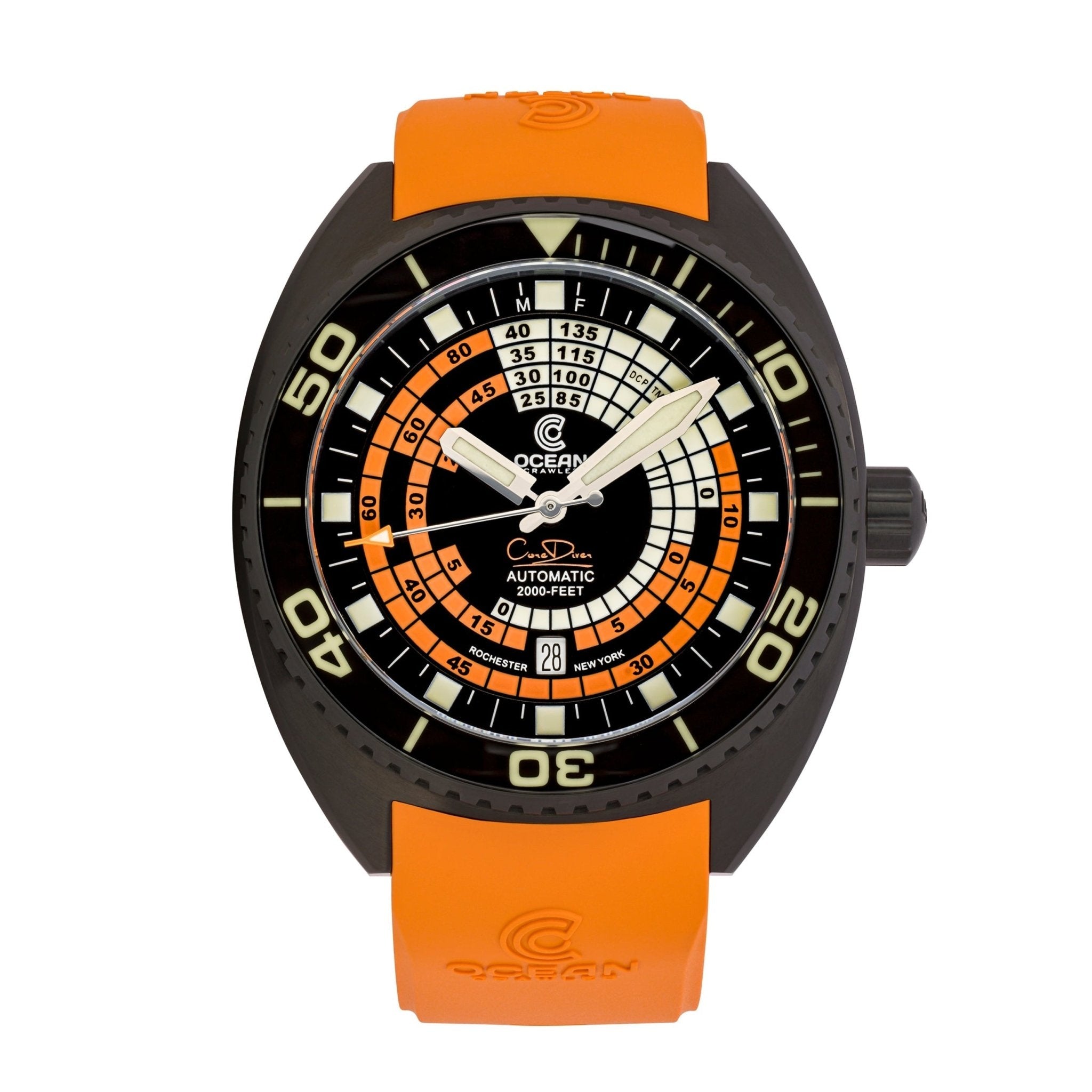
If you have ever come across an old-fashioned-style dive watch that has a series of concentric rainbow-like circles on its face, then you have encountered a decompression timer. From the visual aspect, the watches’ dials are very unique and completely unlike the simple dial faces of regular diving watches. However, the colorful circles are more than just decoration.
In the golden era of submarine exploration, one item that was vital to the diver’s kit was the decompression timer dial. At a time when no dive computer was invented yet, the diver had to determine the time spent underwater as well as the rate of ascent to prevent decompression sickness. Watch manufacturers managed to solve this problem with their inventions.
Currently, these dials are very popular among watch enthusiasts due to their mid-century design and technical brilliance.
This guide will explain everything about the decompression timer dial, from its definition to how the colorful scale works and its significance in the history of diving, along with the differences between it and modern diving apparatuses.
What Is a Decompression Timer Dial?
The Decompression Timer Dial is a specially designed watch dial with concentric circles representing depth and time readings. The diver can use this device for calculating no-decompression times and mandatory decompression stops simply by correlating their maximum depth with elapsed bottom time.
Nitrogen gets dissolved in the body when a scuba diver inhales compressed air while diving underwater. As the depth of the dive increases, so does the amount of nitrogen dissolved in the body. When such a diver rises too fast, the nitrogen gets converted to bubbles, resulting in decompression sickness.
However, to avoid such a situation, divers have to make deliberate stops at certain depths during their ascent process, and this enables them to off-gas. The decompression timer dial simplifies the complicated mathematical charts that enable one to determine the depth of the stop into a colored graphic located under the watch hands.
How Does a Decompression Timer Dial Work?
For one to comprehend the workings of a decompression dial, one has to consider the correlation that exists between three vital elements: depth, time spent, and time taken for the stop.
The majority of decompression dials are constructed with the help of concentric circles. The circles represent the various diving depths (expressed in meters and feet).
The elapsed time in minutes is indicated by numbers on every circle. Alongside these numbers, you will see smaller numbers indicating the time that should be spent in decompression stops at a certain shallow depth (normally between 3 and 5 meters).
The system depends totally on the minute hand of the watch. Once the diver dives into the water, he/she sets the elapsed time (normally by matching the traditional dive bezel to the minute hand). As the minute hand rotates around the dial, it passes through the numbers printed on the concentric rings. All that the diver needs to do is to match the ring indicating the maximum depth he/she plans to achieve, see where the minute hand lies, and read the number of decompressions needed from the dial.
What Do the Colors on a Decompression Dial Mean?
The strikingly colored dial is one of the unique features of a decompression timer watch. It comes in vivid colors like pink, yellow, blue, green, and orange.
It is important to understand that these colors were not picked for any fashion statement. Colors behave in a completely different manner underwater than above water. As you go deeper underwater, different wavelengths of light get absorbed by water, and colors start appearing gray and black.
The alternated colors in a decompression scale work as a tracking aid. The reason why there are rings that are very closely printed is that when diving, the person might end up looking at the wrong ring due to poor vision in the dark waters.
As a result of giving each depth level its own unique color, watch makers made it much easier for the diver to locate and focus on the correct ring and keep track of it as it moves across the dial. This needs to be remembered because the colors are not uniform in their meanings between different manufacturers.
Decompression Timer Dial vs. Dive Watch Bezel
The use of a decompression dial can be easily confused with that of a rotating dive bezel because both of them serve completely different purposes. The bezel indicates the amount of time that you've spent underwater, whereas the dial estimates the effects of the duration.
|
Feature |
Decompression Timer Dial |
Standard Dive Bezel |
|
Primary purpose |
Calculates required decompression stops based on depth and time. |
Measures total elapsed time underwater. |
|
How information is displayed |
Concentric, color-coded rings printed directly on the watch face. |
A rotating outer ring with a 60-minute scale. |
|
Typical historical use |
Determining safe ascent procedures and off-gassing times. |
Tracking basic bottom time or timing safety stops. |
|
Modern relevance |
Primarily an aesthetic, historical tribute; functions as an analog backup. |
Still widely used by divers to track total dive time alongside computers. |
|
Ease of interpretation |
Requires understanding of dive tables and cross-referencing depth with time. |
Highly intuitive; read at a single glance. |
The History of Decompression Timer Watches
The history of decompression timers is inextricably linked to the rapid rise of scuba diving in the 1950s and 1960s that followed the end of the Second World War.
In that period, entities such as the U.S. Navy produced dive tables that specified the no-decompression limits (maximum allowable time at a particular depth) for dives and the corresponding decompression tables. These tables were carried on waterproof plastic slates by commercial and military divers.
However, as recreational scuba diving began to increase in popularity, companies developing diving equipment searched for methods of simplifying the process of planning dives. Clock makers understood that the diver was already using their mechanical clock to measure time. The idea to simply transfer key information from traditional dive tables onto the dial of the clock became an obvious solution.
Swiss watch manufacturers during the 1960s made diving watches with such colorful scales. They were targeted at professional divers, scientists, and recreational hobbyists who saw them as the ultimate technical tool while underwater.
How Were Decompression Timer Watches Used?
Decompressing with the use of a decompression gauge was a disciplined exercise in the past because a watch is not able to tell how deep you are and it is completely dependent on the principle of "square dive profile."
The square dive profile is based on the premise that a person dives to their deepest depth immediately and stays there throughout the dive.
A diver from the 1960s who had to make an exploration in waters at a depth of 40 meters should look at the 40-meter ring on his watch. While he was diving, the diver would follow the minute hand as it moved along this ring. When the minute hand went beyond the no-decompression limit, which is marked on the watch dial, the diver should have known that he was now obliged to make a decompression stop on his way up.
Are Decompression Timer Dials Still Useful Today?
Regarding the main piece of equipment for sustaining life, the answer is negative. The modern diver employs a digital dive computer.
A mechanical decompression timer considers that the whole dive is conducted at the maximum depth, and that is an excessively conservative and strict mathematical approach to planning the dive. On the contrary, a modern dive computer monitors the depth throughout the dive accurately minute by minute.
Having stated this, however, it cannot be denied that decompression timer dials have not become outdated. Professional divers usually wear mechanical diving watches to serve as analog backups in the event that their computer malfunctions. In addition to this, learning how to use a decompression timer dial involves basic knowledge about diving and diving tables.
Why Do Watch Collectors Like Decompression Timer Dials?
If digital computers do all the math for us, then why is there a huge revival of the decompression timer watches?
For watch lovers, it is all about the history, the aesthetics, and the mechanical engineering. The decompression dial is a very unique piece of equipment. It symbolizes the time when watches were taken to their limits for the survival of mankind.
They are very unique in terms of aesthetics. The busy and colorful rings violate every principle associated with minimalist watches, making them an absolute talking point. For collectors, they are unique because of their vintage look, their presence on the wrist, and the heritage that they portray.
Ocean Crawler and the Decompression Timer Dial
Ocean Crawler specializes in the development of professional diving watches that can handle extreme underwater conditions. We have always held in great esteem the rich history of man’s underwater exploration, and it is from here that our Decompression Timer Collection emerged.
Integrated into our renowned Core Diver collection, the interpretation of the decompression timer by us has made this ancient instrument contemporary. Our Ocean Crawler Decompression Timer comes with the traditional concentric ring scale so that you can make the calculations of standard dive tables right from the dial.
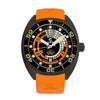
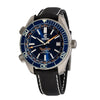
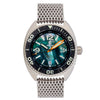
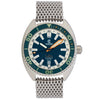
However, we have paired the practicality of the 1950s with the no-nonsense modern specifications. Whether it is the Decompression Timer Blue, Black, or Yellow or the tactical Black DLC version, the watch comes with a heavily domed sapphire crystal glass, impressive water-resistance properties, and a solid Swiss automatic movement.
Through our incorporation of analog technical scales from the 1960s era along with the tough American engineering characteristic of the Core Diver, we have created a watch that celebrates the history of diving without sacrificing strength.
Final Thoughts
The decompression timer dial is really an amazing example of technical creativity invented in the middle of the century. With all complex mathematical computations being reduced to color strips of the wristwatch, the first horologists gave explorers enough courage to investigate the depth of the underwater world.
Nowadays, despite the fact that digital computers are responsible for doing most of the dive calculations, the decompression watch is an emblem of professionalism. It is a personal reminder of the heyday times of diving.
If you would like to buy a robust mechanical diving watch that combines this fascinating item of horology with high performance, we suggest you try our Decompression Timer Collection of the Ocean Crawler Core Diver watches.
Frequently Asked Questions
What is a decompression timer dial?
The decompression timer dial is a unique watch that has concentric rings coded by color. It acts like a portable dive table for computing no-decompression times and decompression stops according to one’s maximum depth and bottom time.
How does a decompression dial work?
Rings are included on the watch face to represent various depths. As the minute hand moves around the face of the watch, it shows numbers printed on the rings. Divers can refer to the ring showing their depth to determine if decompression is necessary.
What do the colored circles on a decompression watch mean?
Different depths are distinguished by the vivid colors. Given that visibility under water is very poor and light is easily absorbed in water, the contrasting colors ensure that the diver does not read the wrong depth indicator and misinterpret the timing.
Is a decompression timer the same as a dive computer?
No. The modern dive computer constantly measures your actual depth and updates your nitrogen ceilings accordingly. The old mechanical decompression timer dial is simply a fixed table that makes calculations based on a fixed depth square profile.
Are decompression timer watches still used for diving?
While contemporary divers use digital dive computers in order to make complicated calculations, professional divers still use mechanical decompression watches as analog devices, and enthusiasts hold them in high regard due to their respect for traditional diving methods.
What is the difference between a decompression bezel and a dive bezel?
The standard dive bezel is an external rotating bezel used for tracking the elapsed time. The decompression gauge is actually imprinted on the watch dial itself, and it is used to figure out the decompression stops needed due to the elapsed time.
Are decompression timer watches mainly for collectors today?
Yes. Since digital devices are much safer and more accurate for contemporary technical diving, today's decompression timers' dials are sought after mostly because of their impressive vintage look, interesting history and mechanics.